Pages

Wednesday, August 28, 2013

Interesting Facts - Automobiles

Accident
 
For every 50 miles driven in an automobile, a person has a 1 in a million chance of being killed in a motoring accident.


Autocar 

In 1906 a car known as the Autocar was manufactured in the United States with a new invention-headlights (they burned kerosene). The Autocar, however, lacked another important accessory, the steering wheel. The driver directed the vehicle by means of a stick-like shaft situated to the right of the driver's seat.


 Cost

In 1924 a Ford automobile cost $265.


 Horn

Most American automobile horns beep in the key of F.


Inventions

The Buick, first automobile manufactured by the General Motors Corporation, was actually built by a man named David Buick. Buick, a plumber by trade, also invented a process whereby porcelain could be annealed onto iron, hence making possible the production of the white porcelain bathtub.


License Fee

No two-cycle engines are allowed in Singapore. The license fee for a new car is low, about $5.00, but as the vehicle gets older, this fee increases. When the automoblie reaches 8 years old, it is no longer allowed on the streets. This is opposite of the license-fee structure in the U.S. While strict, Singapore's auto law has virtually wiped out air pollution in the country. It has also created a booming auto parts export business for companies like www.directfitautoparts.com. They snap up unsold auto parts inventories on older models and then resell the parts to other countries where the cars are still on the road and plentiful.


Most Cars

In 1950 the United States had 70 percent of all the automobiles, buses, and trucks in the entire world.


Price

The price of the average American automobile doubled during the ten-year period between 1968 and 1978.

Racing

The first automobile race ever seen in the United States was held in Chicago in 1895. The track ran from Chicago to Evanston. The winner was J. Frank Duryea, whose average speed was 71.5 miles per hour.

Taxi

The high roofs of London taxicabs were originally designed to keep gentlemen from knocking off their top hats as they entered and left the vehicles.

Theft

In 1905 the Bosco Company of Akron, Ohio, marketed a "collapsible Rubber Automobile Driver." The figure, deflated and kept under the seat when not in use, was a kind of dummy intended to scare thieves away when the car was parked.

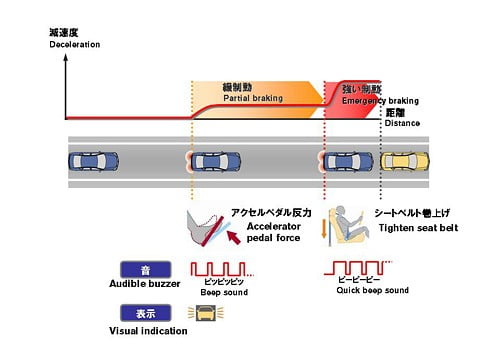
Forward Collision Avoidance Assist Concept By Nissan

Nissan Motor Co., Ltd. announced its “Forward Collision Avoidance Assist Concept,” a new technology designed to address both sides of potential rear end collisions: helping a driver avoid hitting the vehicle ahead in a lane of travel, while also helping reduce the potential risk of sudden braking – being rear-ended by a vehicle approaching from behind. The new system has the capability of avoiding possible collisions at forward speeds of up to approximately 60kph, the highest speed ever for forward collision avoidance systems.
nissan-forward-collision-avoidance-system
The concept utilizes a highly sensitive radar sensor to monitor the distance from the vehicle in front and its relative speed.
When the system judges that deceleration is required, it alerts the driver using both a screen display and sound, then generates a force that pushes the accelerator pedal up and smoothly applies partial braking to assist the driver in slowing the vehicle down.
If the system judges that there is the possibility of a collision, it will automatically apply harder braking and tighten the driver’s seatbelt.

The new “Forward Collision Avoidance Assist Concept” detects the vehicle in front at an earlier stage and generates warnings so that the driver can take action to keep away from a high risk situation. Because the system is designed to help the driver decelerate smoothly, it is also expected to help reduce the risk of the vehicle being rear-ended by another vehicle approaching from behind.
Nissan is promoting the development of safety technologies as part of its “Safety Shield” concept, based on the idea that “vehicles help to protect people.” From the viewpoint that the driver is always the main subject of driving, Nissan places emphasis on assisting the driver intuitively through means such as visual and audio notifications.
source – Nissan


What is Brake Override And How Brake Override Works


With the technology getting advanced each day and cars becoming safer, we present to you a small and important technology article from Car Blog India series of Technology Articles
In this article I will tell you what is brake override and how it works? Also I will tell you what is the need of Brake Override.
IMG_2152

What is Brake Override ?

With cars getting more and more sensors and microprocessors, it is possible to save the passengers from fatal car accidents by using innovative technologies. Brake Override is one such technology which can be a life-saver in case of a stuck throttle. Imagine that due to some reason (god-forbid), if the gas pedal / accelerator of your car gets stuck and its pressed hard, in that case even if you apply brakes really hard, the car won’t come to a stop so easy because the brakes are not fully effective if the throttle is revving the engine high. This can be a vary fatal situation and can cause deadly accidents.
Brake override is an intelligent system which overrides the throttle press and even if the gas pedal / accelerator pedal is fully pressed and you hit the brakes hard, it will bring the engine revs down by releasing the throttle intelligently even if the gas pedal is fully pressed. This ensures that when the brake is press, the engine will lower its RPM and help the car to come to a stop as it normally would if the throttle is not stuck. This technology can save many lives even if this possibility of gas pedal getting stuck is not very high.

We have recently heard and read about some of the mishaps because of unintended acceleration in some faulty cars. Had these cars been equipped with this safety feature, these accidents could not have happened as brakes could have been fully effective.

How Brake Override System Works ?

Well, not going into deep technicalities as there can be more than one ways of making it work, I will just tell you an overview of how Brake Override works. Cars have sensors to determine how much the gas pedal has been depressed, these sensors are a part of MPFI system. Also cars have sensors to determine how hard brakes have been pressed, these sensors are a part of ABS and EBD system. To make brake override work, this information can be used together. When brake is pressed, this information can be used to alert the MPFI system to rev down the car as the brake is depressed and engine should not rev high. I will not go in more details to bore you with technical jargons.

What is the Need Of Brake Override ?

Brake override system can help save lives in rare cases of gas pedal getting stuck. Even though these cases maybe rare, but the value of human life is precious so its makes sense to have this safety feature. Also in another case, if some driver hits brake in panic and his feet get stuck due to panic situation in such way that his feet is on both gas / accelerator pedal and brakes, in that case also this technology can prove to be a life saver.

Brake Override Demonstration Video

Below is a video by BMW demonstrating brake override system in one of their cars:


I am totally impressed by this feature and would love to have a care with this safety feature in it. Although some drag racing  and motor sports enthusiasts may not like this to be in their cars, but for normal passengers, Brake Override is a life saver.

Volvo Zero Emission Concept Car With Air Engine

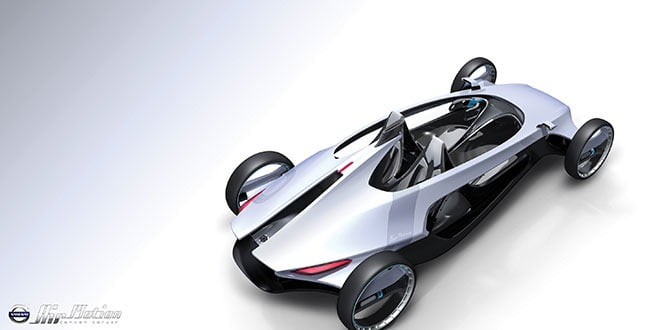
Does it sound like a science fiction to have a car which runs on compressed air and emits no smoke ? Well most technologies have sounded like science fictions before they were actually developed and materialized. Compressed Air Engines can be a futuristic solution to emission problems of today. It is technically possible to run an engine using compressed air and various prototypes have been there for sometime. This time Volvo is making a passenger car concept called the Air Motion which actually runs using the energy of the compressed air.
volvo-air-motion-air-engine-car
It will take a few years for this technology to become ready for everyday use, but till that time lets appreciate the steps towards a greener tomorrow and wait for more such technologies to be developed.

Source – CarBlogIndia Forum | Autopia

What Is Start Stop System? How Does It Save Fuel?

Innovations come along with new products including cars and motorcycles and are necessary in terms of advancement and consumer satisfaction. In today’s world innovations grow like mushrooms with almost every brand offering you a sophisticated technology which you may not understand but is important. If one has to make a choice between luxury and running cost, many of the customers will be inclined towards the running cost or the fuel consumption of the vehicle and to suppress it, numerous innovations and inventions have been done.Start Stop System
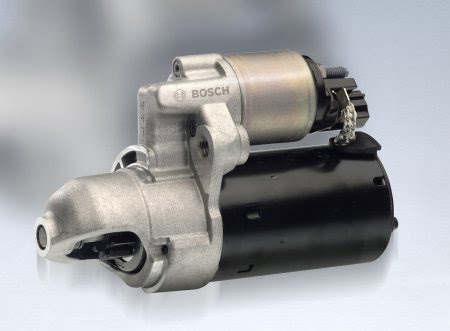
Image Credit – Bosch
Today we will talk about the Start Stop System, which is a system designed to make the optimum use of the fuel in Start-Stop conditions. In 1980s Volkswagen Polo and the Fiat Regta were the first cars to flaunt this new technology which forwarded to Volkswagen Golf in 1994, VW Lupo and Audi A2 3.0 L. Though initially the technology failed to impress many drivers due to its high cost, it was later accepted whole heartedly.
Talking about the Indian manufacturers, the Mahindra & Mahindra has used this technology in Mahindra Scorpio, Bolero MaxiTruck and will soon re-introduce it through its to-be launched Mahindra Xylo Micro Hybrid
.

What Is Start Stop System?

The Start Stop system is based on a simple principle of not burning the fuel when it is not required. The system automatically detects occasions during your drive when the vehicle is idle & stops the engine thus conserving fuel. Thus it aids in attaining better fuel efficiency & reducing running costs.

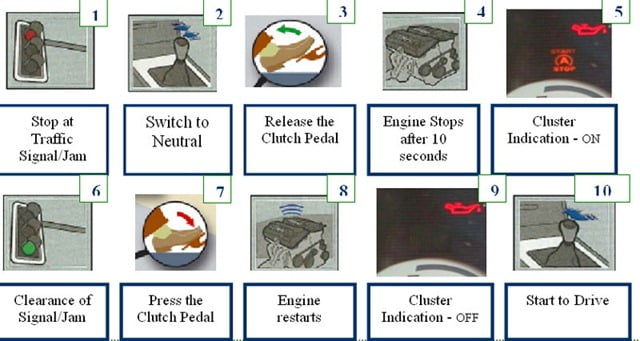
How Start Stop System Works?

  • Vehicle has come to halt due to traffic signal/jam, is in neutral gear.
  • The engine will shut down automatically after 10 seconds. Just before stopping, the indicator in the cluster will blink indicating the engine is going to stop shortly.
  • The indicator will glow on your instrument cluster indicating the engine has stopped due to stop start device.
  • Once the Signal turns green, press the clutch pedal & engine starts immediately.
  • The indicator on the cluster goes off indicating that engine has started again & you are ready to drive on with the vehicle.
Mahindra Start Stop System
Image Credit - Mahindra

Benefits Of Start Stop System

  • Since the engine is switched off during traffic signals/jams, considerable amount of CO2 release to the atmosphere is avoided and eventually reduces global warming.
  • Less Fuel Consumption

Development Cost

A few lakh rupees. The technology certainly has value for money and do hope that other brands consider it an important part for their products as well.

What is a Turbocharger And Supercharger? Automobile Technology

We often hear about new cars and engine technologies, we try to bring them to you through our dedicated technology articles. Today with this post we would like to explain you two of the most used terms, Supercharger and Turbocharger and will also make you understand the difference between them.
Before I start explaining each of them, let me just brief you on why they are actually implemented in cars and what is their purpose. Internal combustion engines i.e four stroke ones, produce a specific amount of horsepower but car lovers who wish to increase the performance of their vehicles, get Turbocharger or Supercharger on their engines. These devices act as as enhancers and increase the horsepower of the vehicle by almost 30 to 40%, thereby adding a lot more thrust.

Turbocharger

turbo
Image Credit-Howstuffworks
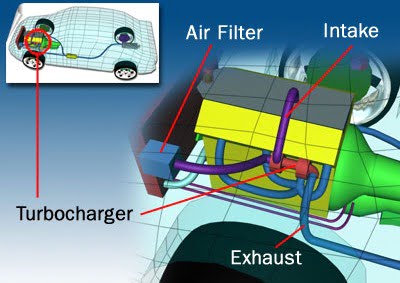
A turbocharger is basically a centrifugal compressor driven by a turbine which is run by the exhaust gases or emission gases coming out of the your car’s engine. The compressor used in the construction compresses the air which is about to enter the engine, to high pressure. With increased pressure, the weight or amount of fuel entering the same space inside the engine is increased. In this way, the burning of fuel is more efficient inside the engine chamber and it eventually results in greater performance of the vehicle from the same displacement of engine without need of a larger displacement engine. For example, if you put 30% more fuel in the same engine cylinder, the burning of that fuel will produce about 30% more power from the same size of engine.

Supercharger

supercharger-6a

Image Credit-Howstuffworks
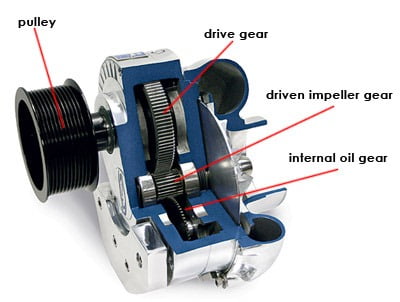
A supercharger is very much similar to a turbocharger with a compressor used for forcing high pressure air into the engine. The major difference being that in case of the supercharger, the engine itself runs the turbocharger whereas in turbocharger, the energy of escaping  exhaust gases or emission, which otherwise goes waste, is used to run the compressor. With more compressed air, more oxygen and fuel reaches the combustion chamber, hence more power is developed.
In general a supercharger and turbocharger are the same sort of arrangements but have a set of characteristics that distinguish the two.

Difference Between Supercharger & Turbocharger

  • Firstly the driving power of the two units is considered. The compressors in Superchargers are driven by the power taken directly from the engine whereas as mentioned above for driving a turbocharger unit the exhaust gases are used. Since the supercharger draws mechanical energy from the engine directly it is less efficient when compared to a turbocharger which uses the waste gas energy.
  • With this advantage of turbochargers over superchargers, the former are used where fuel economy is a concern i.e in many of the present cars, whereas the superchargers are employed in sports cars which are meant for faster speeds and not better economy.
  • Secondly a supercharger is easier to control in terms of the power output while the turbochargers are known for their dramatic rise in pressures and tremendously high working temperatures making them inherently more difficult to control at the time when they deliver the additional power.
  • Another important difference between the two is that since the supercharger is driven directly by the engine through belts, the response of the same is pretty instantaneous and a sudden increase in power is observed. On the other hand in turbochargers, exhaust gases control the drive and hence the system takes a bit of time before it it reaches the operating speed after opening the throttle which is also referred to as Turbo Lag.
  • Complexity in design is another factor and at this point turbocharger takes the lead with its compactness and require significantly less space. In contrast a supercharger is more difficult to adopt in a car and the modification is too time consuming as more space is needed for the same.
  • Expensiveness of the two is quite differentiating with the superchargers being more costly than a conventional turbocharger. Now a days all vehicle having either supercharger or turbocharger, are intercooled. Since the temperature of the compressed incoming air is high, an intercooler is used to cool this air making it more efficient in terms of combustion.
Hope the information we have provided is useful to you and does help you understand these technologies closely.

What Is Cruise Control and Adaptive Cruise Control? – What Is The Difference Between Adaptive Cruise Control and Cruise Control?

New car technologies are invented every now and then but some have been with us for years. In our earlier Automobile technology posts on Car Blog India, we have talked about ABS, EBD,Turbochargers, Superchargers and many other but today we will be talking about a technology which is half a century old and now finds an important place in every luxury car.
In 1945 a blind yet prolific inventor, Mr. Ralph Teetor invented a system which is now one of the most important features of any good car globally, the Cruise Control. The system was first introduced in 1958 with Chrysler models such as Imperial, New Yorker and Windsor and by 1960 all Cadillacs were offered with Cruise Control.
Presently most of the global automobile giants like VolvoMercedes-BenzBMWAudiNissanKiaHondaNissan, etc. offer this feature with most of their cars. Mahindra & Mahindra is also on its way of providing better safety features and offers Cruise Control with Mahindra Scorpio VLX.
image- cruise control mounted on steering

What Is Cruise Control?

Cruise Control is a system which is capable of maintaining the speed of a car at a desired level. The conventional or I would say the basic systems are capable of taking over the throttle once the driver activates Cruise Control and sets the desired speed. In most of the cars, the cruise control buttons are mounted on the steering wheel, just like the audio control buttons, whereas in older car models a separate lever is provided similar to the ones used for windscreen wipers and headlights. The basic ones are often equipped with four buttons: on, off, resume and coast whereas the newer current systems are offered with one or two controls only but are way too convenient. Once enabled the new ones only ask the driver to set the maximum and minimum cruising speeds after which it takes over the controls and the same gets disabled as soon as the driver presses the throttle, brake or clutch pedal.

New car technologies are invented every now and then but some have been with us for years. In our earlier Automobile technology posts on Car Blog India, we have talked about ABS, EBD,Turbochargers, Superchargers and many other but today we will be talking about a technology which is half a century old and now finds an important place in every luxury car.
In 1945 a blind yet prolific inventor, Mr. Ralph Teetor invented a system which is now one of the most important features of any good car globally, the Cruise Control. The system was first introduced in 1958 with Chrysler models such as Imperial, New Yorker and Windsor and by 1960 all Cadillacs were offered with Cruise Control.
Presently most of the global automobile giants like VolvoMercedes-BenzBMWAudiNissanKiaHondaNissan, etc. offer this feature with most of their cars. Mahindra & Mahindra is also on its way of providing better safety features and offers Cruise Control with Mahindra Scorpio VLX.
image- cruise control mounted on steering

What Is Cruise Control?

Cruise Control is a system which is capable of maintaining the speed of a car at a desired level. The conventional or I would say the basic systems are capable of taking over the throttle once the driver activates Cruise Control and sets the desired speed. In most of the cars, the cruise control buttons are mounted on the steering wheel, just like the audio control buttons, whereas in older car models a separate lever is provided similar to the ones used for windscreen wipers and headlights. The basic ones are often equipped with four buttons: on, off, resume and coast whereas the newer current systems are offered with one or two controls only but are way too convenient. Once enabled the new ones only ask the driver to set the maximum and minimum cruising speeds after which it takes over the controls and the same gets disabled as soon as the driver presses the throttle, brake or clutch pedal.

Well Connected Future Cars To Reduce 90% Of Accidents In Next 20 Years– Says IEEE Experts

Intelligent cars are not a part of science fiction movies anymore, they are around us, increasing in numbers as the technology is advancing and getting more affordable. Cars these days have Electronic Stability Programs for safety, ABS for better control, Adaptive Cruise Control to adapt to road speeds, Collision Avoidance System to keep safe distance from cars ahead, Advanced Navigation Systems to keep the commuters from going astray and many other safety features to keep the driver and passengers safe. The only flaw in these technologies is that these technologies don’t interact with other cars. In future, a connected car infrastructure will avoid most of the road crashes, accidents and other mishaps on the roads as per an expert from IEEE(world’s largest technical professional association).
IMG_2437
“Today’s advanced embedded systems, sensors, microprocessors and control technologies have made our vehicles and roads significantly safer, but integrating them into our vehicles and roads has been a slow process,” said Dr. Azim Eskandarian, IEEE member and director of the Center for Intelligent Systems Research at The George Washington University. “However, within 10 years, as technology costs continue to fall and implementation of these technologies increases, we could see significant improvements in vehicle safety, efficiency, and energy conservation – especially in developing parts of the world where high-end cars are not yet affordable by the general public.”
Dr. Eskandarian says other challenges include market acceptance and potential liability concerns surrounding technologies that take total or partial control of the vehicle, such as collision avoidance and driver assistance programs like automatic braking. However, these technologies may follow the path of driver- and passenger-side airbags and anti-lock braking systems (ABS) or electronic stability control (ESC), initially offered as optional features but today considered proven and often standard safety measures in nearly all vehicles.
Advanced research on safety technologies is going far beyond individual vehicles. For example, Teruo Higashino, IEEE Senior Member and professor of information networking at Osaka University in Japan, has focused recently on applying wireless networking technology for vehicle-to-vehicle communication to help detect dangerous vehicles on the road – such as a car approaching a blind intersection – and warn nearby drivers, helping dramatically reduce accidents. Many of these ground-breaking innovations, including vehicle-to-vehicle communication, were discussed at the recently held IEEE ITS Conference in Washington D.C.
Dr. Alberto Broggi, President of the IEEE Intelligent Transportation Systems Society and professor at the Università di Parma in Italy, says intelligent transportation technologies on the horizon, including autonomously-driven vehicles, will forever change our concept of car use. Broggi recently coordinated the successful 13,000 kilometer journey of a driverless van from Italy to China. “These types of self-driven vehicles will be ready for use in non-urban environments within five to eight years,” said Broggi. “The same technology will also apply to agricultural equipment, including self-driven tractors and combines that will maximize land use, increase crop output and decrease injuries.”

Another expected benefit of intelligent transportation technologies is reduced fuel consumption and emissions. IEEE Senior Member Matt Barth, at the Center for Environmental Research and Technology at University of California-Riverside, predicts that fuel use and vehicle emissions can be reduced by 20 to 30 percent worldwide over the next five years using environmentally-friendly ITS technology such as “eco-routing.” This vehicle GPS system capability will allow drivers to select destination routes according to fuel efficiency.
“Many governments are establishing new emissions and fuel efficiency standards for vehicle manufacturers to meet in the next ten years,” Barth said. “The integration of ECO-ITS technologies – such as eco-routing into our vehicles – will be an important evolution in further reducing carbon emissions, achieving greater fuel efficiency, and strengthening energy independence.”
Kyongsu Yi, IEEE member and director of the Vehicle Dynamics and Control Laboratory at Seoul National University in South Korea, said the application of intelligent transportation technologies varies by setting. “There’s much more of a focus on traffic management systems for pedestrian protection in countries in Europe and Asia where cities were traditionally designed around a relatively small and defined city center,” Yi said. “In contrast, in the United States where there are more sprawling open spaces, the emphasis is on vehicle safety systems to prevent roll-overs or collisions with other fast-moving vehicles.”
You can check out more work by IEEE on their official website