Pages

Wednesday, August 28, 2013

Mercedes tops satisfaction survey; overall industry score dips.

Mercedes-Benz became the new leader in the latest American Customer Satisfaction Index, while three Japanese brands led their non-luxury counterparts.
The German luxury automaker scored 88 on a scale of 0 to 100, ascending to the top spot after Lincoln, last year's winner, stopped being measured because of low market share.
Lexus remained the runner-up, scoring 87, down 2 percent from 2012.
Third-place Subaru, Toyota and Honda -- the highest ranking non-luxury nameplates -- each scored 86 -- 3 points above the industry average.
Overall, European manufacturers ranked first with a satisfaction score of 84.7, followed closely by Asian automakers with a score of 84.1, and a score of 82 for U.S. companies.
The American Customer Satisfaction Index, based on phone and e-mail interviews with 4,078 recent customers randomly picked between April 6 and May 22, found that customer satisfaction with automobiles and light vehicles dropped 1.2 percent to an industry wide average of 83, down from 84 in 2012.
The index was started in 1994 and measures customer satisfaction with the quality of 20 foreign and domestic nameplates, along with other factors such as price and the dealership experience.
GMC, 85, tied with Cadillac in fourth place and was the only non-luxury domestic brand north of the industry average.
Ford and Chrysler, which gained 5 points from 2012, tallied scores of 83, matching the industry average.
Dodge and Chevrolet came in last with scores of 79, just below Jeep, with a score of 80.
GMC and Chrysler had the largest percentage increases, both 6 percent. Buick -- which scored 82 -- and Chevrolet had the largest declines, at 6 percent.
ACSI Director David VanAmburg said it's unclear how Ford's decision to reduce the stated fuel economy of the C-Max hybrid could impact next year's rating, saying only it wouldn't be "terribly helpful."
He said the index doesn't focus on a particular model.
Consumer demand
If the U.S. market tightens because of lower consumer demand, competition from Toyota, Subaru and Honda could squeeze Detroit's General Motors, Ford Motor Co. and Chrysler Group.
VanAmburg said American companies will need to attract foreign-brand consumers with competitive pricing and a time-tested strategy: building better cars with higher quality and more features.
"The risk is what happens when that pent up demand is gone, and it certainly isn't going to last forever. It's going to run out at some point and you're going to drop back to more regular levels of demand," VanAmburg said.
"Right now, in the U.S. automakers are churning out cars like crazy. There certainly is some risk there that, on the one hand, they could be stuck with a lot of inventory. On the other hand, even if they're not, what is there to build future growth on? Really, the only thing to build future sales growth on is to do a better job of satisfying customers," he said. "You've got win over some of those purchasers of Asian brands and European brands."
Although U.S. light-vehicle sales continue to rebound, customer satisfaction with automobiles fell in 2013 for the first time in two years.
Despite the drop in 2013 satisfaction levels, the industry's customer satisfaction score still tops the original baseline of 79 in 1994.
Authors of the study said the slight drop in satisfaction may be linked to previous improvements in customer satisfaction with the auto industry.
"Higher levels of customer satisfaction create greater customer expectations that automakers are then challenged to meet -- let alone exceed," the authors said today in releasing the report.
While the slight drop in satisfaction isn't "cataclysmic" for manufacturers, companies should still take note and be wary of waning pent-up demand and excess production, VanAmburg said.
This is especially true for domestic automakers, which are losing ground to foreign companies in perceived quality, he said.
Higher expectations
Recalls can also have an impact on an automaker's score, the authors said. Frequent or highly publicized recalls often create customer dissatisfaction. Vehicles that were recalled at least once in the past year had an average score of 81 compared to a score of 84 for vehicles that were not recalled.
The overall decline in customer satisfaction levels with the auto industry could be viewed as a glass half-full scenario.
Consumers may have been pleased with their previous purchases and now expect their latest vehicles to meet or surpass their expectations, VanAmburg said.
"As the industry has been doing better, particularly since the recession, we've seen higher numbers for many nameplates, and certainly for the industry as a whole. That tends to engender higher expectations in customers the next time they make a purchase," he said. "That can put a little pinch in customer satisfaction as the automakers are challenged to keep meeting and exceeding those customer expectations."
The American Customer Satisfaction Index, created by the University of Michigan's Ross School of Business and now produced by ACSI LLC, is a national economic indicator of consumer evaluations of the quality of products and services available to household consumers in the U.S. market.
ACSI tracks numerous industries and consumer goods and publishes results monthly.

BMW owners vent anger at months-long wait for spare parts.


MUNICH (Bloomberg) -- South African Neels Kilian was as proud as any BMW owner could be when he got his new 3 series in May. After getting into an accident a few weeks later and still waiting today for repairs, he's reconsidering that sentiment.
The resident of Gauteng, South Africa, needs a rear fender replaced before the car is driveable again. In the meantime, he's still making a monthly payment of 8,000 rand ($770) and has to bear additional costs for work travel because he hasn't been offered a loaner.
"This is shocking!" Kilian wrote in an e-mail. "It is impossible to repair my vehicle; why is BMW unable to issue a warning to customers when buying this brand?"
Kilian is among customers across the globe angered by BMW's failure to promptly deliver spare parts to fix their vehicles.
BMW has struggled since the beginning of June to ship components on time because of a new supply-management system being introduced in its central warehouse in Germany. The delays have caused ripple effects globally because orders for BMW's 40 parts-distribution centers originate at the main facility in Dingolfing. The warehouse also directly supplies about 300 repair shops in Germany.
Raimund Nestler, who lives in Ingolstadt, Germany, has been waiting six weeks for a new part that controls engine speed. "I have always been a die-hard BMW driver and am currently driving my seventh BMW, but will consider which brand I'll buy the next time," he said. "For a premium carmaker like BMW, this is particularly disappointing."
About 10 percent of parts are not immediately available in Dingolfing because of the logistics changeover, Manfred Grunert, a spokesman for the automaker, said on Tuesday. BMW has workers on extra shifts to help shorten the wait, and aims to have the new system working properly by early September. "We deeply regret any inconveniences caused to our customers," Grunert said.
Image tarnished
The logistics troubles come as BMW is under pressure to maintain the global luxury sales crown with both Audi and Mercedes-Benz vowing to take the top spot by the end of the decade. The longer the delays drag on, the more BMW's image as a high-end automaker is tarnished.
"The logistics problem is comprehensible, but three months is too long," said Juergen Pieper, a Bankhaus Metzler analyst in Frankfurt. "Damage has certainly occurred. I see a hit to their reputation and a financial burden of tens of millions."
The logistics project -- named ATLAS for Advanced parTs Logistics in After Sales -- was started in Dingolfing in 2009, according to a joint press release at the time from International Business Machines Corp. and SAP AG. IBM, which was the main contractor, said last week that it's no longer involved in setting up the program. SAP is supplying the software for the warehouse management system, the German company said. BMW declined to comment on its suppliers.
Australia woes
Australian Eric Gibson said repairs on his BMW motorcycle have been dragging on for three months.
"I can now ride the bike, but I'm still waiting for one more part, a driving light," Gibson said.
Fellow Australian Lisa Stephenson, who lives in Coolamon, a farming community 480 kilometers (298 miles) northeast of Melbourne, isn't as fortunate. Her mechanic has advised her not to use her BMW, which she needs to get around in her rural area, because the part that needs replacing could cause a fire.
"I've been waiting for five weeks for a fuel elbow," Stephenson said. "My mechanic informed me this week that the part won't arrive until sometime in October. This is extremely frustrating. Shame on BMW. I am one very unhappy customer."
BMW is sending components via airfreight to speed up delivery times and is trying to provide replacement vehicles for waiting customers, Grunert said.
Stephenson and Kilian both said they haven't been offered a loaner.
"BMW is unable to inform me when to expect this part in South Africa or when my vehicle would be repaired," Kilian said. "It could be another four months or so.

How white-haired 'Vette owners helped shape Stingray's design

MONTEREY, Calif. -- About four years ago, when General Motors designers were just starting on the seventh-generation Corvette, Ed Welburn had something of an epiphany while watching his local news.
GM's global head of design happened to catch a segment on a Corvette club gathering at a local Chevrolet dealership. He doesn't recall what the story was about. But one detail stood out: All of the club members had white hair.
"That's what really did it for me," Welburn told me this week while riding shotgun as I drove the 2014 Corvette Stingray through barren coastal mountains during Chevy's media test drive here. "I knew that we had to do something that appeals to younger buyers and to more international buyers."
That partly inspired Welburn to conduct an unprecedented global call for proposals from GM designers scattered across studios from Brazil to India to Korea.
Welburn, 62, figured that by casting such a wide net, he was more likely to end up with the exotic design he was after.
Plus, Welburn figured it would be a good morale builder, which it was. During a recent visit to GM's design studio in Brazil, he noticed one designer's discarded 'Vette sketch still tacked proudly over his desk.
Welburn personally reviewed the hundreds of sketches that flowed into GM's global design center in suburban Detroit. Eventually, the list of candidates was whittled down to 12 scale models, and eventually to two full-sized clay models.
Then it was gut-check time. One of the finalists included the traditional round taillights; the other had a more provocative look, with squared-off taillights.
Welburn concedes that he initially was opposed to discarding the round lights that had been a signature styling cue on every 'Vette since 1963. But then he remembered the snowy-haired Corvette clubbers.
"That image was just etched into my mind," Welburn says.
So squared taillights it is, anchoring a 'Vette design that looks even more angular and fighter jet-esque when seen in the wild. With Stingrays hitting dealerships by early October, we'll see if Welburn's epiphany pays off.


Lamborghini Launches Indian Version Of The Gallardo

Image Credits: Lamborghini Mumbai FB page

For the people in India, Lamborghini celebrates its 50th anniversary in style, with the launch of the limited edition of the model Gallardo LP550-2 with an ex-showroom Maharashtra price of Rs.3.06 crore.

The India Edition Gallardo Sports Car will be limited to only six super-sports cars adorned with the colors of the Indian flag, of which one car has already been sold to a Bangalore-based entrepreneur prior to the launch.

“This is the way we wanted to pay tribute to India and be different. We could have an Indian monument painted on the car for exclusivity, but we decided for the tri-colour theme,” said Pavan Shetty, Head of Operations, Lamborghini India.


The Gallardo LP550-2 Indian edition sports three colours such as arancio borealis (pearl orange), bianco monocerus (white) andverde ithaca (pearl green) on its exterior the tricolour strip of the Indian national flag that run from the front bonnet to the rear engine bonnet.

The interior has also got shades of the tricolor too, with stitching on the driver's seat in verdeulysse (green), on the passenger seat in arancio leonis (orange) and on the doors, center console and dashboard in bianco polar (white).


The India edition Gallardo is also equipped with the front nose lifting facility which provides better ground clearance for Indian road condition, making this as an advantage for Lambo buyers in India.

See our new websitehttp://autoheads.in/ BE A PART OF THE COMMUNITY

MISTAKEN IDENTITY - A News On Bangalore Mirror


Literally, something took me over exasperating while reading Bangalore Mirror published article "HDK's son gifts himself a RS 5-crore Lamborghini", dated 5th July. The reason is, ignorance of information being published - by the most popular publication publishing, mistakenly, about the most exclusive spotted exotic supercar The Lamborghini Aventador LP700-4 as Lamborghini Gallardo LP550-2.

Well, as an AutoHead, I respect the article and no offence to its writers or the medium, however, the fact remains incorrect as the entire article revolves around the Lamborghini Gallardo LP550-2.

The orange-coloured stunner, which is the latest addition to his collection, puts the young Turk, who is getting ready to take the family political legacy forward by simultaneously dabbling in politics and business, in a league all his own. He is the first Bangalorean to own the limited edition model. In fact, the Italian automobile manufacturer has launched only six exclusive limited edition cars in the country. "But Nikhil got it even before the manufacturer formally launched the cars in India. The car was delivered last month," a source close to Kumaraswamy's family told Bangalore Mirror. [As in Bangalore Mirror]

Now, the information above from Bangalore Mirror's 2nd and 3rd paragraph only reflects the actual information in one sentence "The orange-coloured stunner". The remaining lines do not reflect the actual car at all. In fact, the supercar is an Orange (Arancio Argos Pearl Effect) Lamborghini Aventador LP700-4, launched in India in the last quarter of 2011. The six exclusive limited edition cars said above is with regards to the Indian Edition Lamborghini Gallardo. Which would be a limited edition and only six will be produced exclusively for India (read article here http://goo.gl/wj9Pp).

While I can see the table in the BM's article said this, however I had a question in mind. Are we talking about an engine 5.2 litre-10 cylinder V90? I have heard V8, V10, V12 and V6 too, OR was it actually meant to say V90°, which gave another meaning to the "V" if otherwise.

Specification of Lamborghini AventadorLP700-4: The bull is mated with a 6.5 liter V12, 60° engine which unleashes uncensored power of 700bhp at 8250rpm. The bull is capable of reaching 0-100 km/h in 2.9 seconds and can cruise at a top speed of around 350 km/h making theAventador stand among the fastest street-legal cars in the world.

There was a finishing statement to the article saying "Perhaps, the only road where the Lamborghini can be driven at its maximum speed is the NICE Road built by Gowda's other rival, Ashok Kheny! ". Now, this can be quite challenging taking it to the NICE road every time you want to test the bull's patients, I would ask WHY? Since, Bangalore has already seen two Lamborghini Aventador LP700-4 cruising Bangalore roads after dark, this being the third one I have personally seen it gushing on the regular streets like a Bat Mobile.

Exotics in India is now AutoHeads, visit us for more trending new http://autoheads.in/ BE A PART OF THE COMMUNITY

Interesting Facts - Automobiles

Accident
 
For every 50 miles driven in an automobile, a person has a 1 in a million chance of being killed in a motoring accident.


Autocar 

In 1906 a car known as the Autocar was manufactured in the United States with a new invention-headlights (they burned kerosene). The Autocar, however, lacked another important accessory, the steering wheel. The driver directed the vehicle by means of a stick-like shaft situated to the right of the driver's seat.


 Cost

In 1924 a Ford automobile cost $265.


 Horn

Most American automobile horns beep in the key of F.


Inventions

The Buick, first automobile manufactured by the General Motors Corporation, was actually built by a man named David Buick. Buick, a plumber by trade, also invented a process whereby porcelain could be annealed onto iron, hence making possible the production of the white porcelain bathtub.


License Fee

No two-cycle engines are allowed in Singapore. The license fee for a new car is low, about $5.00, but as the vehicle gets older, this fee increases. When the automoblie reaches 8 years old, it is no longer allowed on the streets. This is opposite of the license-fee structure in the U.S. While strict, Singapore's auto law has virtually wiped out air pollution in the country. It has also created a booming auto parts export business for companies like www.directfitautoparts.com. They snap up unsold auto parts inventories on older models and then resell the parts to other countries where the cars are still on the road and plentiful.


Most Cars

In 1950 the United States had 70 percent of all the automobiles, buses, and trucks in the entire world.


Price

The price of the average American automobile doubled during the ten-year period between 1968 and 1978.

Racing

The first automobile race ever seen in the United States was held in Chicago in 1895. The track ran from Chicago to Evanston. The winner was J. Frank Duryea, whose average speed was 71.5 miles per hour.

Taxi

The high roofs of London taxicabs were originally designed to keep gentlemen from knocking off their top hats as they entered and left the vehicles.

Theft

In 1905 the Bosco Company of Akron, Ohio, marketed a "collapsible Rubber Automobile Driver." The figure, deflated and kept under the seat when not in use, was a kind of dummy intended to scare thieves away when the car was parked.

Forward Collision Avoidance Assist Concept By Nissan

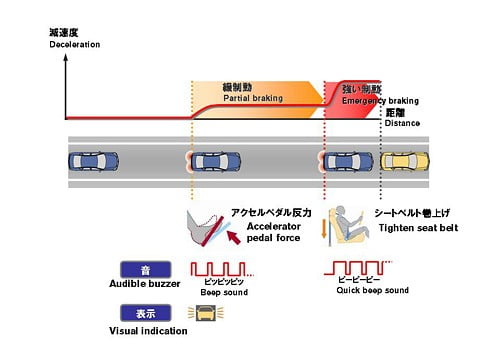
Nissan Motor Co., Ltd. announced its “Forward Collision Avoidance Assist Concept,” a new technology designed to address both sides of potential rear end collisions: helping a driver avoid hitting the vehicle ahead in a lane of travel, while also helping reduce the potential risk of sudden braking – being rear-ended by a vehicle approaching from behind. The new system has the capability of avoiding possible collisions at forward speeds of up to approximately 60kph, the highest speed ever for forward collision avoidance systems.
nissan-forward-collision-avoidance-system
The concept utilizes a highly sensitive radar sensor to monitor the distance from the vehicle in front and its relative speed.
When the system judges that deceleration is required, it alerts the driver using both a screen display and sound, then generates a force that pushes the accelerator pedal up and smoothly applies partial braking to assist the driver in slowing the vehicle down.
If the system judges that there is the possibility of a collision, it will automatically apply harder braking and tighten the driver’s seatbelt.

The new “Forward Collision Avoidance Assist Concept” detects the vehicle in front at an earlier stage and generates warnings so that the driver can take action to keep away from a high risk situation. Because the system is designed to help the driver decelerate smoothly, it is also expected to help reduce the risk of the vehicle being rear-ended by another vehicle approaching from behind.
Nissan is promoting the development of safety technologies as part of its “Safety Shield” concept, based on the idea that “vehicles help to protect people.” From the viewpoint that the driver is always the main subject of driving, Nissan places emphasis on assisting the driver intuitively through means such as visual and audio notifications.
source – Nissan


What is Brake Override And How Brake Override Works


With the technology getting advanced each day and cars becoming safer, we present to you a small and important technology article from Car Blog India series of Technology Articles
In this article I will tell you what is brake override and how it works? Also I will tell you what is the need of Brake Override.
IMG_2152

What is Brake Override ?

With cars getting more and more sensors and microprocessors, it is possible to save the passengers from fatal car accidents by using innovative technologies. Brake Override is one such technology which can be a life-saver in case of a stuck throttle. Imagine that due to some reason (god-forbid), if the gas pedal / accelerator of your car gets stuck and its pressed hard, in that case even if you apply brakes really hard, the car won’t come to a stop so easy because the brakes are not fully effective if the throttle is revving the engine high. This can be a vary fatal situation and can cause deadly accidents.
Brake override is an intelligent system which overrides the throttle press and even if the gas pedal / accelerator pedal is fully pressed and you hit the brakes hard, it will bring the engine revs down by releasing the throttle intelligently even if the gas pedal is fully pressed. This ensures that when the brake is press, the engine will lower its RPM and help the car to come to a stop as it normally would if the throttle is not stuck. This technology can save many lives even if this possibility of gas pedal getting stuck is not very high.

We have recently heard and read about some of the mishaps because of unintended acceleration in some faulty cars. Had these cars been equipped with this safety feature, these accidents could not have happened as brakes could have been fully effective.

How Brake Override System Works ?

Well, not going into deep technicalities as there can be more than one ways of making it work, I will just tell you an overview of how Brake Override works. Cars have sensors to determine how much the gas pedal has been depressed, these sensors are a part of MPFI system. Also cars have sensors to determine how hard brakes have been pressed, these sensors are a part of ABS and EBD system. To make brake override work, this information can be used together. When brake is pressed, this information can be used to alert the MPFI system to rev down the car as the brake is depressed and engine should not rev high. I will not go in more details to bore you with technical jargons.

What is the Need Of Brake Override ?

Brake override system can help save lives in rare cases of gas pedal getting stuck. Even though these cases maybe rare, but the value of human life is precious so its makes sense to have this safety feature. Also in another case, if some driver hits brake in panic and his feet get stuck due to panic situation in such way that his feet is on both gas / accelerator pedal and brakes, in that case also this technology can prove to be a life saver.

Brake Override Demonstration Video

Below is a video by BMW demonstrating brake override system in one of their cars:


I am totally impressed by this feature and would love to have a care with this safety feature in it. Although some drag racing  and motor sports enthusiasts may not like this to be in their cars, but for normal passengers, Brake Override is a life saver.